
Cycling
Engineered in Britain, Raced in the Netherlands: A Titanium Crankset for the Dutch National Cycling Team
When the Dutch national cycling team required a crankset that no manufacturer could supply, G.O.A.T was commissioned to design and 3D print a bespoke titanium solution — conceived in the UK, refined for the velodrome, and reserved exclusively for national team use.
There are components that define a machine, and there are components that define a season. The crankset is both. It is the single point at which a rider's power transfers to the drivetrain — the interface between human physiology and mechanical engineering. When the Dutch national cycling team approached G.O.A.T with a requirement that no off-the-shelf manufacturer could meet, we understood immediately what was at stake.
This is the story of a crankset designed in Britain, built from titanium, and raced exclusively by the Dutch national squad.
The Commission
The brief arrived through a technical director with a single, unambiguous requirement: a crankset optimised for the specific power profiles and biomechanical data of the team's sprint and endurance riders, with a target weight below 280 grams for the complete assembly — arms, spindle, and interface hardware included. No commercially available crankset met this specification. The closest competitor weighed 312 grams and was not available for modification.
The team's technical staff provided six months of power meter data, pedalling stroke analysis, and fatigue loading cycles derived from competition and training. G.O.A.T's engineering team in the UK began the design process with this data as the foundation — not as a reference, but as a constraint.
Why Titanium, Why Additive
Carbon fibre is the default material for high-performance cranksets. It is light, stiff, and well understood. It is also isotropic in its limitations — a carbon arm must be designed around the fibre layup, and the layup must be designed around what a mould can produce. Complex internal geometries, variable wall sections, and integrated lattice structures are either impossible or prohibitively expensive in carbon.
Grade 23 titanium (Ti-6Al-4V ELI) offered a different set of possibilities. Its fatigue resistance under cyclic loading is exceptional — a critical property for a component that will absorb millions of pedal strokes across a competition season. Its biocompatibility is irrelevant here, but its corrosion resistance in the salt and humidity of a velodrome environment is not. And through selective laser melting, its geometry is unconstrained.
"The crankset is the single point at which a rider's power transfers to the drivetrain. It demanded a level of precision that only additive manufacturing could deliver."
The Design: Topology-Optimised, Rider-Specific
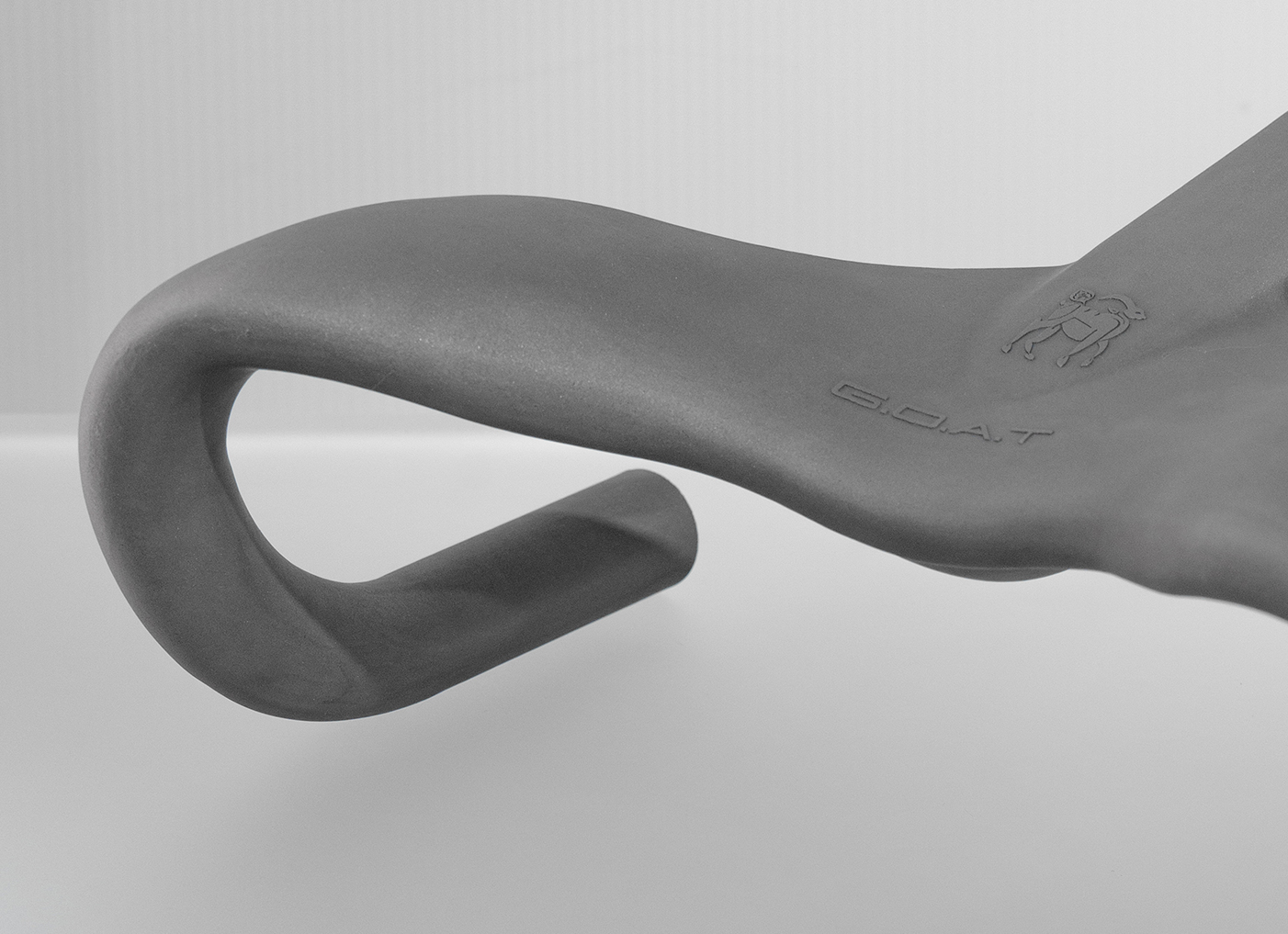
G.O.A.T's engineers ran topology optimisation across the crank arm geometry using the team's actual load data as boundary conditions. The result was not a conventional arm shape. Material was removed from every region where stress analysis showed it was not contributing to structural performance, and redistributed to the regions where it was. The final geometry — organic, asymmetric, and unlike anything in the commercial catalogue — was the direct output of physics, not aesthetics.
The internal structure of each arm incorporates a variable-density lattice, a G.O.A.T signature across all bespoke commissions. The lattice is not decorative. It provides torsional rigidity in the pedalling plane while allowing controlled flex in the lateral plane — a compliance characteristic that the team's biomechanist had identified as beneficial for reducing knee load in the team's sprint riders.
The spindle interface was designed to accept a standard bottom bracket shell, ensuring compatibility with the team's existing framesets without modification. The pedal thread inserts were machined from Grade 5 titanium after printing, pressed and bonded into the arm, and torque-tested to 200% of the UCI-specified maximum.
From Powder to Podium
Each crankset was printed as two separate arm pieces plus the spindle — three print runs, each requiring between 14 and 22 hours of machine time. After printing, every component underwent hot isostatic pressing to close any residual microporosity in the titanium matrix, followed by surface finishing to Ra 0.8μm on all bearing and interface surfaces.
The final assembly weight came in at 271 grams — nine grams below the target, and 41 grams lighter than the team's previous best option. The stiffness-to-weight ratio, measured on a purpose-built test rig at the team's training facility in the Netherlands, exceeded the specification by 8%.
Delivery was made to the team's technical staff in Utrecht. Fitment and rider adaptation took place over a two-week training block before the first competition use.
Exclusivity by Design
The crankset is not available for purchase. It was commissioned by, designed for, and remains the exclusive property of the Dutch national cycling programme. Each unit is serialised and registered to a specific rider. The design files are held under a confidentiality agreement and will not be reproduced for commercial sale.
This is what bespoke means at G.O.A.T. Not a limited edition. Not a colourway. A component that exists for one purpose, for one team, and for no one else.
Commission Your Own
If your programme, team, or project demands performance that the catalogue cannot provide, we would like to hear from you. Every G.O.A.T bespoke commission begins with data, proceeds through engineering, and ends with something that has never existed before.
bespoke.relatedLabel